authorityresearch.com
The Institute Of Authority Research.
Pages From Bloom's Taxonomies
and
Verses and Quotations From Prior Radio Shows.
by
Dean Gotcher
deangotcher@gmail.com
Proverbs 3:5, 6 "Trust in the Lord with all thine heart, and lean not unto thine own understanding. In all thy ways acknowledge him, and he shall direct thy paths."
1 John 2:16 "For all that is in the world, the lust of the flesh, and the lust of the eyes, and the pride of life, is not of the Father, but is of the world."
"By dialectic, I mean an activity of consciousness, struggling to circumvent the limitations imposed by the formal-logical law of contradiction." (Norman O. Brown, Life Against Death: The Psychoanalytical Meaning of History)
Jeremiah 17:9 "The heart is deceitful above all things, and desperately wicked: who can know it?"
Luke 16:15 "And he said unto them, Ye are they which justify yourselves before men; but God knoweth your hearts: for that which is highly esteemed among men is abomination in the sight of God."
Proverbs 16:5 "Every one that is proud in heart is an abomination to the LORD: though hand join in hand, he shall not be unpunished."
Replacing the father ("What does my Father want me to do?") with "the group" (with "What will the group think?"), with the "help" of the facilitator of 'change,' the social-psychologist, the group psychotherapist, the serpent in the group (team building), using "Bloom's Taxonomies" (Marxist) curriclum in the classroom, in the workplace, in government, in the church searing the conscience and damning the soul of all who participate, cursing the nation. It is what is going on with "the corporate," the deep state, the swamp, the shadow government, the military, media, medical, educational, etc., establishment, the drug cartel ("Don't touch our 'drug money' or we will take you out.") in control of the outcome, buying and selling souls, removing anyone who gets in the way, including the unborn, the elderly, the innocent, the righteous without having a guilty conscience (with not remorse), in the name of "the people," aka "What can we get out of this situation, this object, these people, this person, this office for our self, to fulfill our lusts?" Karl Marx: "The philosophers have only interpreted the world in different ways, the objective however, is change." (Eleventh Thesis on Feuerbach) György Lukács (founder of the Frankfurt School,): "... the central problem is to change reality . . . reality with its 'obedience to laws.'" (History and Class Consciousness: What is Orthodox Marxism?)

"Bloom's Taxonomies," are built upon the political system of the Frankfurt School, a group of Marxists who came to the States in the early 30's fleeing Fascist Germany, entering our Universities, making Marxism lovable by the Democratic Party, two members who Bloom sighted as his "Taxonomies" "Weltanschauung1." "1Cf. Erich Fromm, 1941; Theodor W. Adorno, 1950." Fourty years after the publication of the first taxonomy Bloom admitted that it "was unproved at the time it was developed and may well be 'unprovable.'" (Forty Year Evaluation).

Benjamin S. Bloom ("Bloom's Taxonomies,"): "We recognize the point of view that truth and knowledge are only relative and that there are no hard and fast truths which exist for all time and places." (Taxonomy of Educational Objectives Book 1: Cognitive Domain, Dedicated to Ralph Tyler) Friedrich Engels summed up Karl Marx's view of absolutes: "In the eyes of the dialectic philosophy, nothing is established for all times, nothing is absolute or sacred." Benjamin Bloom simply paraphrased Karl Marx, making Marxism the desired (intended) outcome of his "Taxonomy."

Marxism is Lust ("Pandora's box," a box full of evil which once opened can not be closed) => Hate (hatred toward authority, the lid on the box) => Violance; silencing, censoring, removing anyone who gets in the way of their lusts; the fancy car(s), the fancy house(s), the fancy boat(s), the fancy plane(s), the fancy trips, the fancy meals, hanging around fancy men and fancy women, that are dancing in their head. "Rule of law," doing what the Father says is being replaced with "What can I (We) get out of this situation, this object, these people, this person, this office for my self (ourselves), to satisfy my (Our) lusts?" "Group Think." "Bloom's Taxonomies" are "Pandora's box, 'liberating' students from their parent's authority in order for the facilitator of 'change' to "own" them, using them as "human resource" to satisfy their lusts) (Taxonomy of Educational Objectives Book 2: Affective Domain)

"Bloom's Taxonomies" are a psychological classification system" used "to develop attitudes and values . . . which are not shaped by the parents." "There are many stories of the conflict and tension that these new practices are producing between parents and children." (Taxonomy of Educational Objectives Book 2: Affective Domain)

The conscience is the moral standards of the parents, no compromise. The superego is the moral standards of society (the group), compromise. Irvin D. Yalom: "There is no type of past behavior too deviant for a group to accept once therapeutic group norms are established." Dr. Robert Trojanowicz (a Marxist) Explains Where The Guilty Conscience Is "Created.": "The personal conscience is the key element in ensuring self-control, refraining from deviant behavior even when it can be easily perpetrated." "The family, the next most important unit affecting social control, is obviously instrumental in the initial formation of the conscience and in the continued reinforcement of the values that encourage law abiding behavior." (The meaning of "Community" in Community Policing) Norman O. Brown (a Marxist): "The guilty conscience is formed in childhood by the incorporation of the parents and the wish to be father of oneself." "What we call 'conscience' perpetuates inside of us our bondage to past objects now part of ourselves:'" (Life Against Death: The Psychoanalytical Meaning of History) Kurt Lewin (a Marxist): "The negative valence of a forbidden object which in itself attracts the child [the guilty conscience] thus usually derives from an induced field of force of an adult." "If this field of force loses its psychological existence for the child (e.g., if the adult goes away or loses his authority) the negative valence also disappears." (A Dynamic Theory of Personality) When you make dialogue the means to defining and establishing behavior the Father's authority is rejected.

Replacing belief-action dicotomy (Individualism, under God, Family => Nationalism) with theory-action unity (Marxism, Socialism, Communism, Globalism).
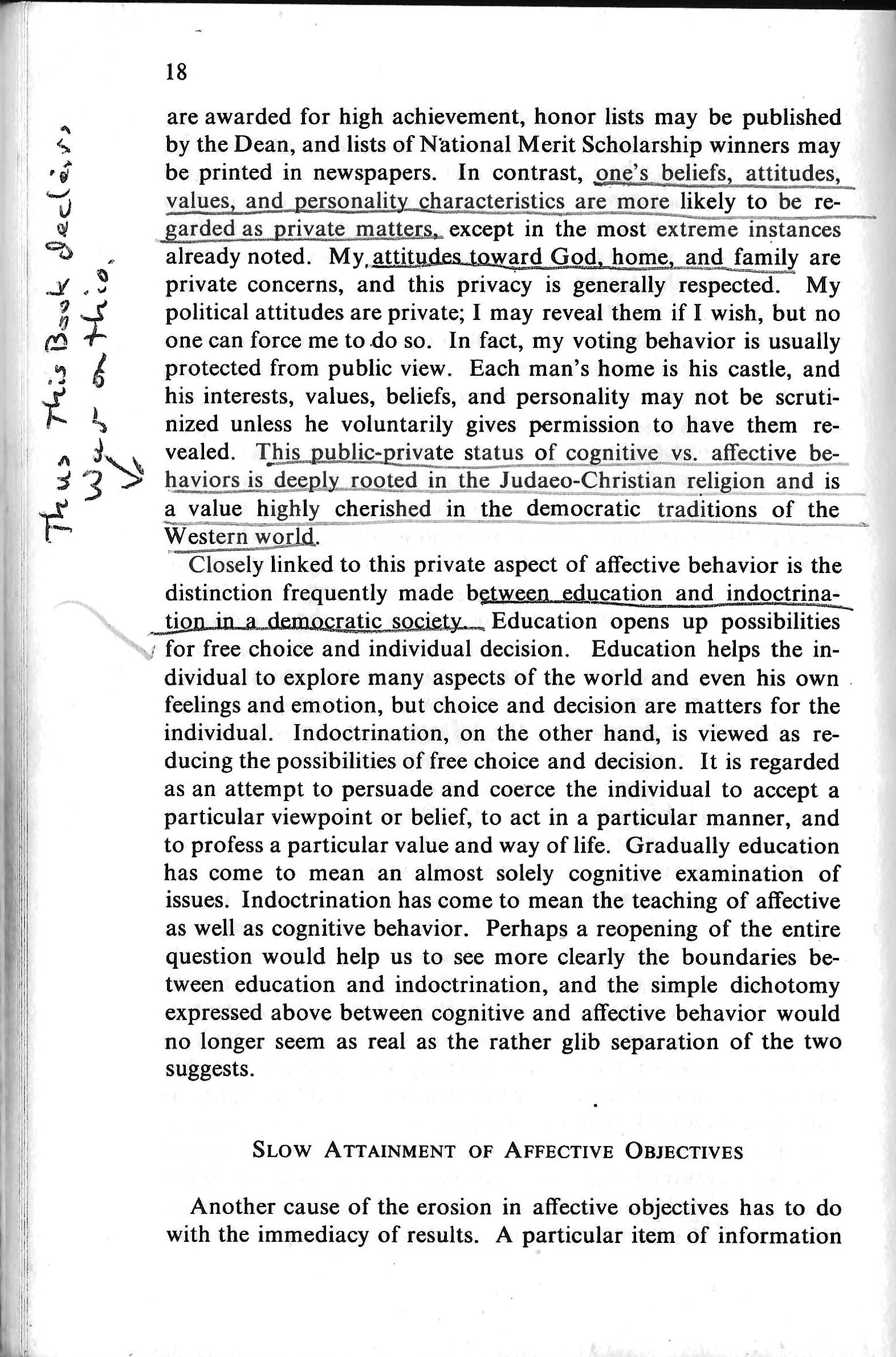
Verses and quotations from prior Radio - sort of Notes. Many repeated with new ones added. What the woman did in the garden in Eden, when she evaluated the tree (from her carnal mind), called aufheben (picking up that which you were not supposed to-you were told not to have anything to do with), she was right in her evaluation. She was wrong in leaving the Father out.
Discussion: "In an ordinary discussion people usually hold relatively fixed positions and argue in favor of their views as they try to convince others to change." (Bohm and Peat, Science, Order, and Creativity)
Bohm (noted for quantum physics) made discussion subject to dialogue, "relatively fixed position," while with the Father it is a "fixed postion." making the Father the one who is arguing with the child when he is telling the child to do something, which the child does not want to do, and "their views" which is not his view but that of the one he is in obedience to.
Dialogue: "A dialogue is essentially a conversation between equals." "The spirit of dialogue, is in short, the ability to hold many points of view in suspension, along with a primary interest in the creation of common meaning." (Bohm and Peat, Science, Order, and Creativity)
Team spirit as in two or more is involved in dialogue, all being equal where in discussion there is one above, who you are not equal with but subject to. In dialogue all are subject to the law of the flesh and the world that stimulates it. Karl Marx called dialogue, Critical Criticism, a "spiritualistic lord."
To "prevent someone who KNOWS from filling the empty space." (Wilfred Bion, A Memoir of the Future )
The objective is to silence, censor, and remove anyone who gets in the way of dialogue, "the empty space" in order for all to sin without having any sense of accountability.
Genesis 2:7 "And the LORD God formed man of the dust of the ground, and breathed into his nostrils the breath of life; and man became a living soul."
Genesis 2:16, 17 "And the LORD God commanded the man, saying, Of every tree of the garden thou mayest freely eat: But of the tree of the knowledge of good and evil, thou shalt not eat of it: for in the day that thou eatest thereof thou shalt surely die."
Genesis 2:18 "And the LORD God said, It is not good that the man should be alone; I will make him an help meet for him."
Genesis 3:1-6 (emphasis added): "Now the serpent was more subtle than any beast of the field which the LORD God had made. And he said unto the woman, Yea, hath God said, Ye shall not eat of every tree of the garden? And the woman said unto the serpent, We may eat of the fruit of the trees of the garden: But of the fruit of the tree which is in the midst of the garden, God hath said, Ye shall not eat of it, neither shall ye touch it, lest ye die. And the serpent said unto the woman, Ye shall not surely die: For God doth know that in the day ye eat thereof, then your eyes shall be opened, and ye shall be as gods. And when the woman saw that the tree was good for food, and that it was pleasant to the eyes, and a tree to be desired to make one wise, she took of the fruit thereof, and did eat, and gave also unto her husband with her; and he did eat."
"To enjoy the present reconciles us to the actual." (Karl Marx, Critique of Hegel's 'Philosophy of Right')
"Not feeling at home in the sinful world, Critical Criticism must set up a sinful world in its own home." "Critical Criticism is a spiritualistic lord, pure spontaneity, actus purus, intolerant of any influence from without." ( Karl Marx, The Holy Family)
"In the dialogic relation of recognizing oneself in the other, they experience the common ground of their existence." (Jürgen Habermas, Knowledge and Human Interest, Chapter Three: The Idea of the Theory of Knowledge as Social Theory)
"Bypassing the traditional channels of 'top-down' decision making our objective center's upon transforming public opinion into an effective instrument of global politics." "Individual values must be measured by their contribution to common [lust] interests and ultimately to world interests, transforming public consensus into one favorable to the emergence of a stable and humanistic world order." "Consensus is both a personal and a political step. It is a precondition of all future steps." Ervin Laszlo, A Strategy For The Future: The Systems Approach to World Order)
"... the hatred against patriarchal suppression—a 'barrier to incest,' . . . the desire (for the sons) to return to the mother culminates in the rebellion of the exiled sons, the collective killing and devouring of the father." (Herbert Marcuse, Eros and Civilization: a psychological inquiry into Freud)
"The individual is emancipated in the social group." "Freud commented that only through the solidarity of all the participants could the sense of guilt be assuaged." "Self-perfection of the human individual is fulfilled in union with the world in pleasure." "According to Freud, the ultimate essence of our being is erotic." "Eros is fundamentally a desire for union with objects in the world." "Eros is the foundation of morality." (Norman O. Brown, Life Against Death: The Psychoanalytical Meaning of History)
"To experience Freud is to partake a second time of the forbidden fruit;" (Brown)
"... the 'original sin' must be committed again: 'We must again eat from the tree of knowledge in order to fall back into the state of innocence.'" (Marcuse)
"The guilty conscience is formed in childhood by the incorporation of the parents and the wish to be father of oneself." "What we call 'conscience' perpetuates inside of us our bondage to past objects now part of ourselves:'" (Brown)
Karl Marx: "Once the earthly family is discovered to be the secret of the Holy family, the former must then itself be destroyed [vernichtet, that is annihilated, that is negated] in theory and in practice." (Karl Marx, Fourth Thesis on Feuerbach)
Karl Marx: "The philosophers have only interpreted the world in different ways, the objective however, is change." (Karl Marx, Eleventh Thesis on Feuerbach, which is inscribed on Karl Marx's tomb)
Heraclitus: "Every grown man of the Ephesians should hang himself and leave the city to the boys."
Carl Rogers: "If we have the power or authority to establish the necessary conditions, the predicted behaviors [our potential ability to influence or control the behavior of groups] will follow." "We can choose to use our growing knowledge to enslave people in ways never dreamed of before, depersonalizing them, controlling them by means so carefully selected that they will perhaps never be aware of their loss of personhood." "We know how to change the opinions of an individual in a selected direction, without his ever becoming aware of the stimuli which changed his opinion." "We know how to influence the ... behavior of individuals by setting up conditions which provide satisfaction for needs of which they are unconscious, but which we have been able to determine." We can achieve a sort of control under which the controlled though they are following a code much more scrupulously than was ever the case under the old system, nevertheless feel free. They are doing what they want to do, not what they are forced to do." "By a careful design, we control not the final behavior, but the inclination to behavior—the motives, the desires, the wishes. The curious thing is that in that case the question of freedom never arises."
Bloom: "Certainly the Taxonomy was unproved at the time it was developed and may well be 'unprovable.'" (Benjamin Bloom, Forty Year Evaluation)
Benjamin Bloom: "Bloom's Taxonomies" are "a psychological classification system" used "to develop attitudes and values ... which are not shaped by the parents," "What we are classifying is the intended behavior of students—the ways in which individuals are to act, think, or feel as the result of participating in some unit of instruction." "… ordering and relating the different kinds of affective behavior." "… we need to provide the range of emotion from neutrality through mild to strong emotion, probably of a positive, but possibly also of a negative, kind." "… organized into value systems and philosophies of life …" "...many of these changes are produced by association with peers who have less authoritarian points of view, as well as through the impact of a great many courses of study in which the authoritarian pattern is in some ways brought into question while more rational and nonauthoritarian behaviors are emphasized." "The student must feel free to say he disliked _____ and not have to worry about being punished for his reaction." "A large part of what we call "good teaching" is the teacher's ability to attain affective objectives through challenging the student's fixed beliefs" "The affective domain is, in retrospect, a virtual 'Pandora's Box.' " "The affective domain contains the forces that determine the nature of an individual's life and ultimately the life of an entire people." "There are many stories of the conflict and tension that these new practices are producing between parents and children." (David Krathwohl, Benjamin S. Bloom, Taxonomy of Educational Objectives Book 2: Affective Domain; commonly referred to as by which )
Benjamin S. Bloom: "We recognize the point of view that truth and knowledge are only relative and that there are no hard and fast truths which exist for all time and places." (Benjamin S. Bloom, Taxonomy of Educational Objectives Book 1: Cognitive Domain)
Karl Marx's ideology, as explained by Friedrich Engels was the same as Benjamin Bloom's. He wrote "In the eyes of the dialectic philosophy, nothing is established for all times, nothing is absolute or sacred."
Bloom: "Weltanschauung"
Erick Fromm: "We are proud that in his conduct of life man has become free from external authorities, which tell him what to do and what not to do." "All that matters is ... to give up 'God' ..." (Erick Fromm, Escape from Freedom)
Theodor Adorno: "Our aim is not merely to describe prejudice [what the Father says] but to explain it in order to help in its eradication. Eradication means re-education [replacing discussion, what the Father says with dialogue, how the child feels and what he thinks in his classroom experience]." (Theodor Adorno, The Authoritarian Personality)
Theodor Adorno: "The individual may have 'secret' thoughts which he will under no circumstances reveal to anyone else if he can help it. To gain access is particularly important, for here may lie the individual's potential." (Theodor Adorno, The Authoritarian Personality)
Theodor Adorno: ". . . a tendency to transmit mainly a set of conventional rules and customs, may be considered as interfering with the development of a clear-cut personal identity in the growing child." (Theodor Adorno, The Authoritarian Personality)
Theodor Adorno: "Family relationships are characterized by fearful subservience to the demands of the parents and by an early suppression of impulses not acceptable to them." "God is conceived more directly after a parental image and thus as a source of support and as a guiding and sometimes punishing authority." "Submission to authority, desire for a strong leader, subservience of the individual to the state [parental authority, local control, Nationalism], and so forth, have so frequently and, as it seems to us, correctly, been set forth as important aspects of the Nazi creed that a search for correlates of prejudice had naturally to take these attitudes into account." "The power-relationship between the parents, the domination of the subject's family by the father or by the mother, and their relative dominance in specific areas of life also seemed of importance for our problem."
Norman Brown: "Human consciousness can be liberated from the parental complex only by being liberated from its cultural derivatives, the paternalistic state and the patriarchal God." "Freud and Hegel are, like Marx, compelled to postulate external domination and its assertion by force in order to explain repression." "The repression of normal adult sexuality is required only by cultures which are based on patriarchal domination." "Adult sexuality, restricted by rules, to maintain family and society, is a clear instance of that subordination of the pleasure-principle to the reality principle [which Brown defines as the father's authority, doing right and not wrong according to his standards] which is repression; and therefore leads to neurosis [that is the child having to do the father's/Father's will while wanting to do his own instead, having a guilty conscience when he does his own thing, making him neurotic]." "According to Freud, the ultimate essence of our being is erotic, and demands activity according to the pleasure-principle. The foundation on which the man of the future will be built is already there, in the repressed unconscious; the foundation has to be recovered [this is where the use of dialogue in the classroom when it comes to establish behavior comes in]." "In the words of Thoreau: 'We need pray for no higher heaven than the pure senses can furnish, a purely sensuous life. Our present senses are but rudiments of what they are destined to become.'" (Norman O. Brown, Life Against Death: The Psychoanalytical Meaning of History)
Colossians 2:8 "Beware lest any man spoil you through philosophy and vain deceit, after the tradition of men, after the rudiments of the world, and not after Christ."
Ephesians 5:5-7 "Let no man deceive you with vain words: for because of these things cometh the wrath of God upon the children of disobedience. Be not ye therefore partakers with them."
Martin Luther wrote, regarding education: "I greatly fear that the universities, unless they teach the Holy Scriptures diligently and impress them on the young students, are wide gates to hell. I would advise no one to send his child where the Holy Scriptures are not supreme. Every institution that does not unceasingly pursue the study of God's word becomes corrupt." (Luther's Works: Vol. 1, The Christian in Society)
Martin Luther: "Miserable Christians, whose words and faith still depend on the interpretations of men and who expect clarification from them! This is frivolous and ungodly. The Scriptures are common to all, and are clear enough in respect to what is necessary for salvation and are also obscure enough for inquiring minds . . . let us reject the word of man." (Luther's Works: Vol. 32, Career of the Reformer:
Father = authority + enforce = guilty conscience
Group/society = compromise + enforce = "super-ego"
Max Horkheimer: "Protestantism was the strongest force in the extension of cold rational individualism." (Max Horkheimer, Reasoning and Self Preservation)
Jürgen Habermas: "If the 'restoring of life' of the world is to be conceived in terms of the Christian revelation, then Marx must collapse into a bottomless abyss." (Jürgen Habermas, Theory and Practice)
Karl Marx "It is not individualism that fulfills the individual, on the contrary it destroys him. Society is the necessary framework through which freedom and individuality are made realities." (Karl Marx, in John Lewis, The Life and Teachings of Karl Marx)
Carl Rogers: "Prior to therapy the person is prone to ask himself, 'What would my parents want me to do?' During the process of therapy the individual comes to ask himself, 'What does it mean to me?'" "Experience is, for me, the highest authority." "Neither the Bible nor the prophets, neither the revelations of God can take precedence over my own direct experience." (Carl Rogers, on becoming a person: A Therapist View of Psychotherapy)
Proverbs 3:5, 6 "Trust in the Lord with all thine heart, and lean not unto thine own understanding. In all thy ways acknowledge him, and he shall direct thy paths."
Ephesians 2:8, 9 "For by grace are ye saved through faith; and that not of yourselves: it is the gift of God: Not of works, lest any man should boast."
Hebrews 11:6 "But without faith it is impossible to please him: for he that cometh to God must believe that he is, and that he is a rewarder of them that diligently seek him."
Romans 10:17 "So then faith cometh by hearing, and hearing by the word of God."
Matthew 4:4 "But he answered and said, It is written, Man shall not live by bread alone, but by every word that proceedeth out of the mouth of God."
1 John 2:16 "For all that is in the world, the lust of the flesh, and the lust of the eyes, and the pride of life, is not of the Father, but is of the world."
Isaiah 55:8, 9 "For my thoughts are not your thoughts, neither are your ways my ways, saith the LORD. For as the heavens are higher than the earth, so are my ways higher than your ways, and my thoughts than your thoughts."
Matthew 6:24 "No man can serve two masters: for either he will hate the one, and love the other; or else he will hold to the one, and despise the other. Ye cannot serve God and mammon."
Romans 6:16 "Know ye not, that to whom ye yield yourselves servants to obey, his servants ye are to whom ye obey; whether of sin unto death, or of obedience unto righteousness?"
Discussion = Father: "In an ordinary discussion people usually hold relatively fixed positions and argue in favor of their views as they try to convince others to change." (Bohm and Peat, Science, Order, and Creativity)
Dialogue = World: "A dialogue is essentially a conversation between equals." "The spirit of dialogue, is in short, the ability to hold many points of view in suspension, along with a primary interest in the creation of common meaning." (Bohm and Peat, Science, Order, and Creativity)
T, A, S
Jeremiah 17:9 "The heart is deceitful above all things, and desperately wicked: who can know it?"
Luke 16:15 "And he said unto them, Ye are they which justify yourselves before men; but God knoweth your hearts: for that which is highly esteemed among men is abomination in the sight of God."
Proverbs 16:25 "There is a way that seemeth right unto a man, but the end thereof are the ways of death."
Carl Rogers: "The words 'seem to' are significant; it is the perception which functions in guiding behavior."
"By dialectic, I mean an activity of consciousness, struggling to circumvent the limitations imposed by the formal-logical law of contradiction." (Norman O. Brown, Life Against Death: The Psychoanalytical Meaning of History)
"In the dialogic relation of recognizing oneself in the other, they experience the common ground of their existence." (Jürgen Habermas, Knowledge and Human Interest, Chapter Three: The Idea of the Theory of Knowledge as Social Theory)
"Bypassing the traditional channels of 'top-down' decision making our objective center's upon transforming public opinion into an effective instrument of global politics." "Individual values must be measured by their contribution to common [lust] interests and ultimately to world interests, transforming public consensus into one favorable to the emergence of a stable and humanistic world order." "Consensus is both a personal and a political step. It is a precondition of all future steps." Ervin Laszlo, A Strategy For The Future: The Systems Approach to World Order)
A diverse group of people, which must include the deviant, dialoguing their opinions to a consensus, over social-personal issues, in a facilitated meeting, to a predetermined outcome that no decision be made with a diverse group of people, . . . ., is a soviet, which prevents the Father and His authority from having any say in the outcome.
Hebrews 12:5-11: "And ye have forgotten the exhortation which speaketh unto you as unto children, My son, despise not thou the chastening of the Lord, nor faint when thou art rebuked of him: For whom the Lord loveth he chasteneth, and scourgeth every son whom he receiveth. If ye endure chastening, God dealeth with you as with sons; for what son is he whom the father chasteneth not? But if ye be without chastisement, whereof all are partakers, then are ye bastards, and not sons. Furthermore we have had fathers of our flesh which corrected us, and we gave them reverence: shall we not much rather be in subjection unto the Father of spirits, and live? For they verily for a few days chastened us after their own pleasure; but he for our profit, that we might be partakers of his holiness. Now no chastening for the present seemeth to be joyous, but grievous: nevertheless afterward it yieldeth the peaceable fruit of righteousness unto them which are exercised thereby."
Romans 7:7 "I had not known sin, but by the law: for I had not known lust, except the law had said, Thou shalt not covet."
Romans 3:20 ". . . for by the law is the knowledge of sin."
Law comes from the Father who authors commands, rules, facts, and truth and enforces them engendering a guilty conscience in those who adhere to His authority, thus carrying the Father's authority into the world.
Karl Marx: "Once the earthly family is discovered to be the secret of the Holy family, the former must then itself be destroyed in theory and in practice." (Karl Marx, Fourth Thesis on Feuerbach)
György Lukács, History and Class Consciousness: What is Orthodox Marxism?: "... the central problem is to change reality.… reality with its 'obedience to laws.'"
Kurt Lewin, A Dynamic Theory of Personality: "The negative valence of a forbidden object which in itself attracts the child [the guilty conscience] thus usually derives from an induced field of force of an adult." "If this field of force loses its psychological existence for the child (that is, if the adult goes away or loses his authority) the negative valence also disappears."
Remove the Father's authority while 'justifying' lust and the guilty conscience is negated allowing man to sin without fear of being judged, condemned, and cast out so he can remove anything that gets in the way of his lusts without having a guilty conscience.
Irvin D. Yalom, The Theory and Practice of Group Psychotherapy: "... few individuals, as Asch has shown, can maintain their objectivity in the face of apparent group unanimity; and the individual rejects critical feelings toward the group at this time to avoid a state of cognitive dissonance. To question the value or activities of the group, would be to thrust himself into a state of dissonance. Long cherished ... beliefs and attitudes may waver and decompose in the face of a dissenting majority."
Ernest R. Hilgard, Introduction to Psychology; Cognitive dissonance is "the lack of harmony between what one does and what one believes." "The pressure to change either one’s behavior or ones belief."
Kurt Lewin, in Kenneth Benne's book Human Relations in Curriculum Change: "It is usually easier to change individuals formed into a group than to change any one of them separately." "The individual accepts the new system of values and beliefs by accepting belongingness to the group."
Kurt Lewin, Resolving social conflicts: Selected papers on group dynamics: "The group to which an individual belongs is the ground for his perceptions, his feelings, and his actions"
Kurt Lewin in Wilbur Brookover's, A Sociology of Education: "The child takes on the characteristic behavior of the group in which he is placed. . . . he reflects the behavior patterns which are set by the adult leader of the group."
Barker, Dembo, and Lewin, "frustration and regression: an experiment with young children" in Child Behavior and Development: "Change in methods of leadership is probably the quickest way to bring about a change in the cultural atmosphere of a group." "Any real change of the culture of a group is, therefore, interwoven with the changes of the power constellation within the group."
Replacing traditional leadership with facilitator of 'change,' discussion with dialogue and the deed is done.
"Be positive not negative." To "prevent someone who KNOWS from filling the empty space." (Wilfred Bion, A Memoir of the Future )
2 Timothy 4:3, 4 "For the time will come when they will not endure sound doctrine; but after their own lusts shall they heap to themselves teachers, having itching ears; And they shall turn away their ears from the truth, and shall be turned unto fables."
2 Peter 2:3 "And through covetousness shall they with feigned words make merchandise of you."
Genesis 3:1-6: "Now the serpent was more subtle than any beast of the field which the LORD God had made. And he said unto the woman, Yea, hath God said, Ye shall not eat of every tree of the garden? [this is a neurolinguistic construct (an imbedded statement in a question, sensitizing a person to their lusts, when it comes to right and wrong behavior, beginning the process of liberating a person's lust out from under their fear of judgment, that is out from under the father's authority, bringing dialogue forward out from under the restraint of discussion)—which is one of the most powerful forms of hypnosis] And the woman said unto the serpent, We may eat of the fruit of the trees of the garden: But of the fruit of the tree which is in the midst of the garden, God hath said, Ye shall not eat of it, neither shall ye touch it [she revealed her lust], lest ye die. And the serpent said unto the woman, Ye shall not surely die [removing the "negative," that is fear of judgment (which was not a lie regarding the here-and now, that is the tree itself did not kill her—or Adam—but a lie regarding the there-and then, with God removing her—and Adam—from having access to the "tree of life" for their disobedience, then, after death both coming to judgment, that is inheriting eternal life or eternal death) what happened when they disobeyed was the soul was darkened, covered by sin, by lust; Ephesians 4:18 "Having the understanding darkened, being alienated from the life of God through the ignorance that is in them, because of the blindness of their heart:"]:" Genesis 3:5, 6 "For God doth know that in the day ye eat thereof, then your eyes shall be opened, and ye shall be as gods (which dialogue does, everyone is a god in dialogue), knowing good and evil [according to their carnal nature]. And when the woman saw that the tree was good for food, and that it was pleasant to the eyes, and a tree to be desired to make one wise [evaluating (aufheben) from her senses, that is from her understanding she made her self, her self interest, her carnal nature the establisher of right and wrong behavior], she took of the fruit thereof, and did eat, and gave also unto her husband with her; and he did eat."
Psalms 10:3, 4 "For the wicked boasteth of his heart's desire, and blesseth the covetous, whom the LORD abhorreth. The wicked, through the pride of his countenance, will not seek after God: God is not in all his thoughts."
2 Timothy 3:2-5 "For men shall be lovers of their own selves, covetous, boasters, proud, blasphemers, disobedient to parents, unthankful, unholy, Without natural affection, trucebreakers, false accusers, incontinent, fierce, despisers of those that are good, Traitors, heady, highminded, lovers of pleasures more than lovers of God; Having a form of godliness, but denying the power thereof: from such turn away."
Psalms 36:1-4 "The transgression of the wicked saith within my heart, that there is no fear of God before his eyes. For he flattereth himself in his own eyes, until his iniquity be found to be hateful. The words of his mouth are iniquity and deceit: he hath left off to be wise, and to do good. He deviseth mischief upon his bed; he setteth himself in a way that is not good; he abhorreth not evil."
Romans 8:12-15 "Therefore, brethren, we are debtors, not to the flesh, to live after the flesh. For if ye live after the flesh, ye shall die: but if ye through the Spirit do mortify the deeds of the body, ye shall live. For as many as are led by the Spirit of God, they are the sons of God. For ye have not received the spirit of bondage again to fear; but ye have received the Spirit of adoption, whereby we cry, Abba, Father."
Benjamin Bloom: "Bloom's Taxonomies" are "a psychological classification system" used "to develop attitudes and values ... which are not shaped by the parents," "A large part of what we call "good teaching" is the teacher's ability to attain affective objectives through challenging the student's fixed beliefs" "The affective domain is, in retrospect, a virtual 'Pandora's Box.' " "There are many stories of the conflict and tension that these new practices are producing between parents and children."
Bloom: "Weltanschauung" Erick Fromm, Theodor Adorno.
Strauss Vs. Strauss., 1941 wrote: "Every system of law known to civilized society generated from or had as its component one of two well-known systems of ethics, stoic or Christian. The COMMON LAW draws its subsistence from the latter, its roots go deep into that system, the Christian concept of right and wrong or right and justice motivates every rule of equity. It is the guide by which we dissolve domestic frictions and the rule by which all legal controversies are settled."
Heraclitus: "Every grown man of the Ephesians should hang himself and leave the city to the boys." (Heraclitus's ideology, based upon dialogue influenced the Stoics, Karl Marx's hero).
Karl Marx, Critique of Hegel's 'Philosophy of Right' wrote: "The justice of state constitutions is to be decided not on the basis of Christianity, not from the nature of Christian society but from the nature of human society."
ROE v. WADE, 1973 : "there has always been strong support for the view that life does not begin until live birth. This was the belief of the Stoics."
James Coleman, (Equality of Opportunity), The Adolescent Society: "In the traditional society each child is at the mercy of his parents. The 'natural processes' by which they socialize him makes him a replica of them." "Equality of Opportunity [freedom to lust] becomes ever greater with the weakening of family power." "One of the consequence of the increasing social liberation of adolescents is the increasing inability of parents to enforce norms, a greater and greater tendency for the adolescent community to disregard adult dictates." "Strengthening the family to draw the adolescent back into it faces serious problems, as well as some questions about its desirability." "The family has little to offer the child in the way of training for his place in the community."
Textus Receptus = Discussion VS Heresy doctrines = Dialogue
Proverbs 3:5, 6 "Trust in the Lord with all thine heart, and lean not unto thine own understanding. In all thy ways acknowledge him, and he shall direct thy paths."
Ephesians 2:8, 9 "For by grace are ye saved through faith; and that not of yourselves: it is the gift of God: Not of works, lest any man should boast."
Discussion: "In an ordinary discussion people usually hold relatively fixed positions and argue in favor of their views as they try to convince others to change." (Bohm and Peat, Science, Order, and Creativity)
Dialogue: "A dialogue is essentially a conversation between equals." "The spirit of dialogue, is in short, the ability to hold many points of view in suspension, along with a primary interest in the creation of common meaning." (Bohm and Peat, Science, Order, and Creativity)
To "prevent someone who KNOWS from filling the empty space." (Wilfred Bion, A Memoir of the Future )
Karl Marx: "Not feeling at home in the sinful world, Critical Criticism must set up a sinful world in its own home." "Critical Criticism is a spiritualistic lord, pure spontaneity, actus purus, intolerant of any influence from without." (Karl Marx, The Holy Family)
Romans 7:7 "I had not known sin, but by the law: for I had not known lust, except the law had said, Thou shalt not covet."
Romans 3:20 ". . . for by the law is the knowledge of sin."
Law comes from the Father who authors commands, rules, facts, and truth and enforces them engendering a guilty conscience in those who adhere to His authority, thus carrying the Father's authority into the world. Discussion with the Father is the Father telling you what you can and can not say or do, with the Father having the final say.
György Lukács, History and Class Consciousness: What is Orthodox Marxism?: "... the central problem is to change reality.… reality with its 'obedience to laws.'"
Ephesians 5:5-7 "Let no man deceive you with vain words: for because of these things cometh the wrath of God upon the children of disobedience. Be not ye therefore partakers with them."
2 Peter 2:3 "And through covetousness shall they with feigned words make merchandise of you."
Romans 6:16 "Know ye not, that to whom ye yield yourselves servants to obey, his servants ye are to whom ye obey; whether of sin unto death, or of obedience unto righteousness?"
Remove the Father's authority, that which is "negative" while 'justifying' lust, that which is "positive," which includes approval by "the group," and the guilty conscience is negated allowing the child to sin without fear of being judged, condemned, and cast out so he can remove anything that gets in the way of his lusts without having a guilty conscience. Dialogue, when it comes to behavior makes the child God, having the final say.
Replacing traditional leadership with facilitator of 'change,' thus replacing discussion with dialogue and the deed is done. The Father enforces established commands, rules, facts, and truth. The Facilitator of 'change' enforces the child's and therefore his carnal nature, his lusting after the carnal pleasure of the 'moment' that the world is stimulating, 'justifying' his removal the Father and His authority from the environment in order for him to sin without being judged, condemned, and cast out, in order for him to can sin without having a guilty conscience, with everyone's affirmation.
The objective of those who are "of and for the world," facilitators of 'change,' psychotherapists is to prevent parent's from controlling the thoughts of the child. That is to prevent discussion from controlling dialogue. That is to prevent established commands, rules, facts, and truth getting in the way of the child's natural inclination to lust after pleasure and hate restraint. While we, being both flesh and soul have both discussion and dialogue we can only use one at a time, making one subject to the other. The soul KNOWS by being told. The flesh by feelings or "sense experience." Making discussion subject to dialogue, that is facts subject to feelings makes the soul subject to the flesh, 'justifying' in the mind of the child his not having to listen to the Father, resulting in him doing his will instead of the Father's. Those "of and for the world," facilitators of 'change,' psychotherapists remove the Father and His authority from the environment in order for everyone (including themselves) to do what they want without fear of being judged, condemned, and cast out. The facilitator of 'change,' the psychotherapist perceiving his self as being the personification of "the people," who, like him lust after the carnal pleasures of the moment the world stimulates, hating restraint, sees it as his duty to 'justify' the child's natural inclination to lust after pleasure in order to 'justify' his natural inclination to lust after pleasure. When you question the facilitator of 'change's' actions he will respond with "It is not just about you," really meaning "It is all about me, so I can lust after pleasure without having a guilty conscience, with your affirmation. If you refuse to affirm me, that is my lusts or get in my way 'the people' will remove (negate) you (since having 'justified' their lusts I now 'own' them). It appears I must keep an eye on you from now on for my 'good.'"
A diverse group of people, which must include the deviant, dialoguing their opinions to a consensus, over social-personal issues, in a facilitated meeting, to a predetermined outcome that no decision be made with a diverse group of people, . . . ., is a soviet, which prevents the Father and His authority from having any say in the outcome.
"Relationships built on self interest." Government run by contracts.
What is missing in dialogue: Since there is no Father's authority dialogue, there therefore no inheritance, no posterity, no history, no tradition, no unalienable rights, no sovereignty, no representative government, no limited government, no local control, no culture, no heritage, no absolutes or established commands, rules, facts, and truth, no private convictions, no private property, no private business, no "limits and measures," no being wrong, no having to humble, deny, die to, discipline, control, capitulate your "self" in order to do right and not wrong according to established commands, rules, facts, and truth, therefore there is no contrition, no repentance, no forgiveness, no salvation, no conversion, no redemption, and no reconciliation necessary for doing wrong, disobeying, sinning, fellowship is replaced with relationship, position is replaced with feelings, etc. They are all missing (negated) in and through dialogue. Your lust for the pleasure of the 'moment' blinds you to all you are giving up.
Federal Grant called BSTEP, Behavior Science in Teacher Education Program (December 31, 1969) which reads: "During the period of innovation, an environment is invisible. The present is always invisible because the whole field of attention is so saturated with it. It becomes visible only when is has been superseded by a new environment."
Innovation = change, alteration, revolution, upheaval, transformation, metamorphosis, reorganization, restructuring, rearrangement, recasting
Ronald Havelock in A Change Agent's Guide to Innovation in Education wrote: A "change agent... should know about the process of change, how it takes place and the attitudes, values and behaviors that usually act as barriers.... He should know who in his system are the 'defenders' or resisters of innovations."
Karl Marx: "The philosophers have only interpreted the world in different ways, the objective however, is change." (Karl Marx, Eleventh Thesis on Feuerbach, which is inscribed on Karl Marx's tomb)
Carl Rogers: "If we have the power or authority to establish the necessary conditions, the predicted behaviors [our potential ability to influence or control the behavior of groups] will follow." "We can choose to use our growing knowledge to enslave people in ways never dreamed of before, depersonalizing them, controlling them by means so carefully selected that they will perhaps never be aware of their loss of personhood." "We know how to change the opinions of an individual in a selected direction, without his ever becoming aware of the stimuli which changed his opinion." "We know how to influence the ... behavior of individuals by setting up conditions which provide satisfaction for needs of which they are unconscious, but which we have been able to determine." We can achieve a sort of control under which the controlled though they are following a code much more scrupulously than was ever the case under the old system, nevertheless feel free. They are doing what they want to do, not what they are forced to do." "By a careful design, we control not the final behavior, but the inclination to behavior—the motives, the desires, the wishes. The curious thing is that in that case the question of freedom never arises."
Irvin D. Yalom, in his book The Theory and Practice of Group Psychotherapy wrote: "Without exception, [children] enter group therapy [the "group grade" classroom] with the history of a highly unsatisfactory experience in their first and most important group—their primary family [the traditional home with parents telling them what they can and can not do]." "What better way to help [the child] recapture the past than to allow him to re-experience and reenact ancient feelings [resentment, hostility] toward parents in his current relationship to the therapist [the facilitator of 'change]? The [facilitator of 'change'] is the living personification of all parental images [takes the place of the parent]. Group [facilitators] refuse to fill the traditional authority role: they do not lead in the ordinary manner, they do not provide answers and solutions [teach right from wrong from established commands, rules, facts, and truth], they urge the group [the children] to explore and to employ its own resources [to dialogue their "feelings," that is their desires and dissatisfactions of the 'moment' in the "light" of the current situation, that is their desire for "the group" approval (affirmation)]. The group [children] must feel free to confront the [the facilitator of 'change'], who must not only permit, but encourage, such confrontation [rebellion and anarchy]. [The child] reenacts early family scripts in the group and, if therapy [that is brainwashing] is successful, is able to experiment with new behavior, to break free from the locked family role [submitting to the father's authority, that is doing the father's will] he once occupied. . . . the patient [the child] changes the past by recreating it ['creating' a "new" world order from his "ought," that is a world which "lusts," that is a world void of the father's authority and the guilty conscience which the father's authority engenders for doing wrong, disobeying, sinning, that is for "lusting . . ."]."
The Marxist Kurt Lewin, the father of Unfreezing, Moving or Changing, Refreezing People, Force Field Analysis, and Group Dynamics wrote "A successful change includes, therefore, three aspects: unfreezing the present level, moving to the new level, and freezing group life on the new level."
Edger Schein and Warren Bennis explained what "unfreezing" is. "In brief, unfreezing is the breaking down of the morels, customs and traditions of an individual – the old ways of doing things – so that he is ready to accept new alternatives." (Edger Schein and Warren Bennis, Personal and Organizational Change Through Group Methods: The Laboratory Approach)
Warren Bennis, Interpersonal Dynamics: Essays in Readings on Human Interaction: "The manner in which the prisoner came to be influenced to accept the Communist's definition of his guilt can best be described by distinguishing two broad phases—(1) a process of 'unfreezing,' in which the prisoner's physical resistance, social and emotional supports, self-image and sense of integrity, and basic values and personality were undermined, thereby creating a state of 'readiness' to be influence; and (2) a process of 'change,' in which the prisoner discovered how the adoption of 'the people's standpoint' and a reevaluation of himself from this perspective would provide him with a solution to the problems created by the prison pressure."
"Most were put into a cell containing several who were further along in reforming themselves and who saw it as their primary duty to 'help' their most backward member to see the truth about himself in order that the whole cell might advance. Each such cell had a leader who was in close contact with the authorities for purposes of reporting on the cell's progress and getting advice on how to handle the Western member . . . the environment undermined the (clients) self-image."
". . . Once this process of self-re-evaluation began, the (client) received all kinds of help and support from the cell mates and once again was able to enter into meaningful emotional relationships with others." (Interpersonal Dynamics: Essays in Readings on Human Interaction, ed. Warren G. Bennis, Edgar H. Schein, David E. Berlew, and Fred I. Steele)
Benjamin Bloom in his book second "taxonomy," Book 2: Affective Domain wrote: "To create effectively a new set of attitudes and values, the individual must undergo great reorganization of his personal beliefs and attitudes and he must be involved in an environment which in many ways is separated from the previous environment in which he was developed. . . . many of these changes are produced by association with peers who have less authoritarian points of view, as well as through the impact of a great many courses of study in which the authoritarian pattern is in some ways brought into question while more rational and nonauthoritarian behaviors are emphasized." "The effectiveness of this new set of environmental conditions is probably related to the extent to which the students are 'isolated' from the home during this period of time." ". . . objectives can best be attained where the individual is separated from earlier environmental conditions and when he is in association with a group of peers who are changing in much the same direction and who thus tend to reinforce each other." (David Krathwohl, Benjamin S. Bloom, Taxonomy of Educational Objectives Book 2: Affective Domain)
00:39 Discussion will not save you but without it you can not be saved.
1 John 2:16 "For all that is in the world, the lust of the flesh, and the lust of the eyes, and the pride of life, is not of the Father, but is of the world." Discussion, being told is of the Father. Dialogue, stimulus-response is of the world. If you have been told you can not have or do it and you are desirous to have or do it it is lust, therefore sin if you covet it.
Romans 7:7 "I had not known sin, but by the law: for I had not known lust, except the law had said, Thou shalt not covet."
Romans 3:20 ". . . for by the law is the knowledge of sin."
01:00 Actual definition of Discussion and Dialogue.
Discussion: "In an ordinary discussion people usually hold relatively fixed positions and argue in favor of their views as they try to convince others to change." (Bohm and Peat, Science, Order, and Creativity)
Dialogue: "A dialogue is essentially a conversation between equals." "The spirit of dialogue, is in short, the ability to hold many points of view in suspension, along with a primary interest in the creation of common meaning." (Bohm and Peat, Science, Order, and Creativity)
02:24 Man created by God. The soul KNOWS by being told (discussion). The flesh by "sense experience" (dialogue). Then God created woman for dialogue.
Genesis 2:7 "And the LORD God formed man of the dust of the ground, and breathed into his nostrils the breath of life; and man became a living soul."
Genesis 2:16, 17 "And the LORD God commanded the man, saying, Of every tree of the garden thou mayest freely eat: But of the tree of the knowledge of good and evil, thou shalt not eat of it: for in the day that thou eatest thereof thou shalt surely die."
Genesis 2:18 "And the LORD God said, It is not good that the man should be alone; I will make him an help meet for him."
03:12 Father = authors and enforces
In traditional education, replicating the Father's authority system the teacher preaches commands and rules to be obeyed, teaches facts and truth to be learned and applied, and discusses with the students any questions they might have at the teacher's discretion, providing he or she deems it necessary, has time, the students are able to understand, or are not (using dialogue) questioning, challenging, disregarding, defying, attacking authority, rewards and encourages the students who do right and obey, corrects the student who does wrong, chastens the student who disobeys, and casts out (that is grounds or expels) the student who (dialoguing) questions, challenges, defies, disregards, or attacks the teacher's authority, thus initiating or sustaining the Father's authority in the students way of thinking and acting. In contemporary education on the other hand the teacher, as a facilitator of 'change' 'creates' a safe place-space- zone, a "be positive not negative," open-ended, non-directive environment where the students, as a group, which must be inclusive, that is be "tolerant of ambiguity," that is include the deviant and-or immoral student, dialogue their opinions to a consensus (to a feeling of oneness) over personal-social issues without fear of being judged, condemned, or cast out, 'liberating' themselves from the Father's authority so they can lust after pleasure and hate restraint without having a guilty conscience, with one another's affirmation.
04:20
In discussion God is God. You KNOW from being told. Right or Wrong. Commands, rules, facts, and truth based. Absolute. In dialogue you are God. Of the flesh subject to the world. Stimulus-response. Like, do not like, do not care, etc.,. Feelings based. Approach pleasure and avoid pain which includes the missing out on pleasure. Subject to 'change.'
05:38
You can not take dialogue to discussion, making discussion subject to dialogue or you become God equal with, therefore over, therefore against God, negating the Father's authority, negating doing what you are told.
05:50
Discussion is faith. Dialogue is sight
06:00 Dopamine: The drug of pleasure. The drug of choice (for the flesh). The drug of dialogue.
07:20 Chastening gets you off the drug. Detoxes you.
07:30
The child is not in love with the toy. The child is in love with the dopamine the toy stimulates. Man is not in love with the things of the world. He is in love with the dopamine the things of the world stimulates.
"Relationships built upon self interest" is Marxism where lust for pleasure, dopamine negates faith in God, being told. Karl Marx: "To enjoy the present reconciles us to the actual." (Karl Marx, Critique of Hegel's 'Philosophy of Right')
08:30
Picture of family = good dopamine moment. Picture of another woman than your wife, to lust after = bad dopamine moment.
10:00
"It is written." You do not control dopamine. If you lust after it it controls you. The Father gets you off of its control over you. Those "of and for the world," as drug pushers "own" you when you are lusting after therefore controlled by dopamine, lusting after the drug. 2 Peter 2:3 "And through covetousness shall they with feigned words make merchandise of you."
10:30
James 1:14, 15 "But every man is tempted, when he is drawn away of his own lust, and enticed. Then when lust hath conceived, it bringeth forth sin: and sin, when it is finished, bringeth forth death."
10:45
Jeremiah 17:9 "The heart is deceitful above all things, and desperately wicked: who can know it?"
11:15
Romans 7:18 "For I know that in me (that is, in my flesh,) dwelleth no good thing:"
James 1:17 "Every good gift and every perfect gift is from above, and cometh down from the Father of lights, with whom is no variableness, neither shadow of turning."
11:20 Paradigm: way of feeling, thinking, and acting toward your self, toward others, toward the world, and toward authority.
11:40 You are accountable to your soul, not your flesh, to setting your affections on things above and not on the things of the earth.
11:50
Romans 5:13 "For until the law sin was in the world: but sin is not imputed when there is no law."
Romans 3:23-26 "For all have sinned, and come short of the glory of God; Being justified freely by his grace through the redemption that is in Christ Jesus: Whom God hath set forth to be a propitiation through faith in his blood, to declare his righteousness for the remission of sins that are past, through the forbearance of God; To declare, I say, at this time his righteousness: that he might be just, and the justifier of him which believeth in Jesus."
György Lukács, History and Class Consciousness: What is Orthodox Marxism?: "... the central problem is to change reality.… reality with its 'obedience to laws.'"
12:40 Chastening = off the drug.
Hebrews 12:5-11: "And ye have forgotten the exhortation which speaketh unto you as unto children, My son, despise not thou the chastening of the Lord, nor faint when thou art rebuked of him: For whom the Lord loveth he chasteneth, and scourgeth every son whom he receiveth. If ye endure chastening, God dealeth with you as with sons; for what son is he whom the father chasteneth not? But if ye be without chastisement, whereof all are partakers, then are ye bastards, and not sons. Furthermore we have had fathers of our flesh which corrected us, and we gave them reverence: shall we not much rather be in subjection unto the Father of spirits, and live? For they verily for a few days chastened us after their own pleasure; but he for our profit, that we might be partakers of his holiness. Now no chastening for the present seemeth to be joyous, but grievous: nevertheless afterward it yieldeth the peaceable fruit of righteousness unto them which are exercised thereby."
14:30
2 Timothy 4:3, 4 "For the time will come when they will not endure sound doctrine; but after their own lusts shall they heap to themselves teachers, having itching ears; And they shall turn away their ears from the truth, and shall be turned unto fables."
15:50
John 5:30 Jesus said: "I can of mine own self do nothing: as I hear, I judge: and my judgment is just; because I seek not mine own will, but the will of the Father which hath sent me." Matthew 12:50 "For whosoever shall do the will of my Father which is in heaven, the same is my brother, and sister, and mother." Matthew 23:9 "And call no man your father upon the earth: for one is your Father, which is in heaven." Luke 9:23-26 "And he said to them all, If any man will come after me, let him deny himself, and take up his cross daily, and follow me. For whosoever will save his life shall lose it: but whosoever will lose his life for my sake, the same shall save it. For what is a man advantaged, if he gain the whole world, and lose himself, or be cast away? For whosoever shall be ashamed of me and of my words, of him shall the Son of man be ashamed, when he shall come in his own glory, and in his Father's, and of the holy angels."
16:50
2 Timothy 2:15 "Study to shew thyself approved unto God, a workman that needeth not to be ashamed, rightly dividing the word of truth."
17:49
Galatians 3:13 "Christ hath redeemed us from the curse of the law, being made a curse for us: for it is written, Cursed is every one that hangeth on a tree:"
Hebrews 12:2 "Looking unto Jesus the author and finisher of our faith; who for the joy that was set before him endured the cross, despising the shame, and is set down at the right hand of the throne of God."
Luke 9:23 "And he said to them all, If any man will come after me, let him deny himself, and take up his cross daily, and follow me."
20:30
2 Timothy 3:2-5 "For men shall be lovers of their own selves, covetous, boasters, proud, blasphemers, disobedient to parents, unthankful, unholy, Without natural affection, trucebreakers, false accusers, incontinent, fierce, despisers of those that are good, Traitors, heady, highminded, lovers of pleasures more than lovers of God; Having a form of godliness, but denying the power thereof: from such turn away."
Ephesians 2:2, 3 "Wherein in time past ye walked according to the course of this world, according to the prince of the power of the air, the spirit that now worketh in the children of disobedience: Among whom also we all had our conversation in times past in the lusts of our flesh, fulfilling the desires of the flesh and of the mind; and were by nature the children of wrath, even as others."
Colossians 3:5-10 "Mortify therefore your members which are upon the earth; fornication, uncleanness, inordinate affection, evil concupiscence, and covetousness, which is idolatry: For which things' sake the wrath of God cometh on the children of disobedience: In the which ye also walked some time, when ye lived in them. But now ye also put off all these; anger, wrath, malice, blasphemy, filthy communication out of your mouth. Lie not one to another, seeing that ye have put off the old man with his deeds; And have put on the new man, which is renewed in knowledge after the image of him that created him:"
Romans 8:12-15 "Therefore, brethren, we are debtors, not to the flesh, to live after the flesh. For if ye live after the flesh, ye shall die: but if ye through the Spirit do mortify the deeds of the body, ye shall live. For as many as are led by the Spirit of God, they are the sons of God. For ye have not received the spirit of bondage again to fear; but ye have received the Spirit of adoption, whereby we cry, Abba, Father."
21:51
Do not let dopamine get in the way of salvation and eternal life. Money is stored up drug money if you lust after it.
Mark 10:17-23 "And when he was gone forth into the way, there came one running, and kneeled to him, and asked him, Good Master, what shall I do that I may inherit eternal life? 18And Jesus said unto him, Why callest thou me good? there is none good but one, that is, God. Thou knowest the commandments, Do not commit adultery, Do not kill, Do not steal, Do not bear false witness, Defraud not, Honour thy father and mother. And he answered and said unto him, Master, all these have I observed from my youth. Then Jesus beholding him loved him, and said unto him, One thing thou lackest: go thy way, sell whatsoever thou hast, and give to the poor, and thou shalt have treasure in heaven: and come, take up the cross, and follow me. And he was sad at that saying, and went away grieved: for he had great possessions. And Jesus looked round about, and saith unto his disciples, How hardly shall they that have riches enter into the kingdom of God!"
22:30
John 8:36 "If the Son therefore shall make you free, ye shall be free indeed."
22:40
2 Corinthians 7:14 "Therefore if any man be in Christ, he is a new creature: old things are passed away; behold, all things are become new."
1 Peter 1:8 "Whom having not seen, ye love; in whom, though now ye see him not, yet believing, ye rejoice with joy unspeakable and full of glory:"
Philippians 4:7 "And the peace of God, which passeth all understanding, shall keep your hearts and minds through Christ Jesus."
23:35
Romans 5:8 "But God commendeth his love toward us, in that, while we were yet sinners, Christ died for us."
24:10
Proverbs 16:25 "There is a way that seemeth right unto a man, but the end thereof are the ways of death."
25:30
Matthew 4:1 "Then was Jesus led up of the Spirit into the wilderness to be tempted of the devil."
Hebrews 2:18 "For in that he himself hath suffered being tempted, he is able to succour them that are tempted."
29:20
Luke 17:21 "Neither shall they say, Lo here! or, lo there! for, behold, the kingdom of God is within you."
1 Corinthians 3:16, 17 "Know ye not that ye are the temple of God, and that the Spirit of God dwelleth in you? If any man defile the temple of God, him shall God destroy; for the temple of God is holy, which temple ye are."
John 14:20 "At that day ye shall know that I am in my Father, and ye in me, and I in you."
29:30
Matthew 18:20 "For where two or three are gathered together in my name, there am I in the midst of them."
1 John 1:3 ". . . and truly our fellowship is with the Father, and with his Son Jesus Christ."
1 John 2:15 "Love not the world, neither the things that are in the world. If any man love the world, the love of the Father is not in him."
32:30
Genesis 9:1 "And God blessed Noah and his sons, and said unto them, Be fruitful, and multiply, and replenish the earth."
Genesis 11:4 "And they said, Go to, let us build us a city and a tower, whose top may reach unto heaven; and let us make us a name, lest we be scattered abroad upon the face of the whole earth."
34:00 antichrist devices
1 John 2:22 "He is antichrist, that denieth the Father and the Son."
Karl Marx: "Once the earthly family is discovered to be the secret of the Holy family, the former must then itself be destroyed in theory and in practice." (Karl Marx, Fourth Thesis on Feuerbach)
2 Corinthians 2:11 "Lest Satan should get an advantage of us: for we are not ignorant of his devices." Speaking of forgiving:
2 Corinthians 11:3 "But I fear, lest by any means, as the serpent beguiled Eve through his subtilty, so your minds should be corrupted from the simplicity that is in Christ."
Genesis 3:1-6 (emphasis added): "Now the serpent was more subtle than any beast of the field which the LORD God had made. And he said unto the woman, Yea, hath God said, Ye shall not eat of every tree of the garden? And the woman said unto the serpent, We may eat of the fruit of the trees of the garden: But of the fruit of the tree which is in the midst of the garden, God hath said, Ye shall not eat of it, neither shall ye touch it, lest ye die. And the serpent said unto the woman, Ye shall not surely die: For God doth know that in the day ye eat thereof, then your eyes shall be opened, and ye shall be as gods. And when the woman saw that the tree was good for food, and that it was pleasant to the eyes, and a tree to be desired to make one wise, she took of the fruit thereof, and did eat, and gave also unto her husband with her; and he did eat."
35:30
Karl Marx: "The life which he has given to the object sets itself against him as an alien and hostile force." (Karl Marx, MEGA I-3)
36:30
Gnosticism is knowing from "sense experience," 'reasoning' from the flesh and the world that stimulates it, walking by sight. God demands we KNOW from being told, 'reasoning' from the Word of God, walking by faith. All of creation, except the soul of man is subject to the laws of nature, stimulus-response, established by God, once and for all. Man, his soul is subject to the law of God, which is established once and for all, which man can not fulfill, it being perfect and him 'reasoned' from his flesh instead of from the Word of God, from being told, having sinned. Nothing in the creation can save man from God's judgment upon him for his sins, for his 'reasoning' from his flesh, doing his will instead of reasoning from the Word of God, doing God's will.
Romans 7:14-25 "For we know that the law is spiritual: but I am carnal, sold under sin. For that which I do I allow not: for what I would, that do I not; but what I hate, that do I. If then I do that which I would not, I consent unto the law that it is good. Now then it is no more I that do it, but sin that dwelleth in me. For I know that in me (that is, in my flesh,) dwelleth no good thing: for to will is present with me; but how to perform that which is good I find not. For the good that I would I do not: but the evil which I would not, that I do. Now if I do that I would not, it is no more I that do it, but sin that dwelleth in me. I find then a law, that, when I would do good, evil is present with me. For I delight in the law of God after the inward man: But I see another law in my members, warring against the law of my mind, and bringing me into captivity to the law of sin which is in my members. O wretched man that I am! who shall deliver me from the body of this death? I thank God through Jesus Christ our Lord. So then with the mind I myself serve the law of God; but with the flesh the law of sin."
In Christ Jesus, who, having done the Father's will fulfilled the law, dying for our sin we are redeemed from God's wrath, 'reconciled' to God by the Son's resurrection (by the Father).
"By dialectic, I mean an activity of consciousness, struggling to circumvent the limitations imposed by the formal-logical law of contradiction." (Norman O. Brown, Life Against Death: The Psychoanalytical Meaning of History)
Carl Rogers: "Prior to therapy the person is prone to ask himself, 'What would my parents want me to do?' During the process of therapy the individual comes to ask himself, 'What does it mean to me?'" "Experience is, for me, the highest authority." "Neither the Bible nor the prophets, neither the revelations of God can take precedence over my own direct experience." (Carl Rogers, on becoming a person: A Therapist View of Psychotherapy)
All of dialectic 'reasoning' "What can I get out of this situation, object, person, or these people for my self?" is Gnostic reasoning, 'reasoning' from our flesh and the world that stimulates it instead of reasoning from God's Word, from being told, "What does the Father want me to do?" which requires faith,
42:00
Martin Luther wrote, regarding education: "I greatly fear that the universities, unless they teach the Holy Scriptures diligently and impress them on the young students, are wide gates to hell. I would advise no one to send his child where the Holy Scriptures are not supreme. Every institution that does not unceasingly pursue the study of God's word becomes corrupt." (Luther's Works: Vol. 1, The Christian in Society)
Martin Luther: "Miserable Christians, whose words and faith still depend on the interpretations of men and who expect clarification from them! This is frivolous and ungodly. The Scriptures are common to all, and are clear enough in respect to what is necessary for salvation and are also obscure enough for inquiring minds . . . let us reject the word of man." (Luther's Works: Vol. 32, Career of the Reformer)
45:10
Hebrews 11:6 "But without faith it is impossible to please him: for he that cometh to God must believe that he is, and that he is a rewarder of them that diligently seek him."
Romans 10:17 "So then faith cometh by hearing, and hearing by the word of God."
Ephesians 2:8, 9 "For by grace are ye saved through faith; and that not of yourselves: it is the gift of God: Not of works, lest any man should boast."
Matthew 16:26 "For what is a man profited, if he shall gain the whole world, and lose his own soul? or what shall a man give in exchange for his soul?"
Revelation 10:15 "And whosoever was not found written in the book of life was cast into the lake of fire."
Acts 4:12 "Neither is there salvation in any other: for there is none other name under heaven given among men, whereby we must be saved."
Psalms 107:1 "O give thanks unto the LORD, for he is good: for his mercy endureth for ever."
46:20
"If God gives you a check" should say "a check in the spirit."
46:30
Matthew 7:21-23 "Not every one that saith unto me, Lord, Lord, shall enter into the kingdom of heaven; but he that doeth the will of my Father which is in heaven. Many will say to me in that day, Lord, Lord, have we not prophesied in thy name? and in thy name have cast out devils? and in thy name done many wonderful works? And then will I profess unto them, I never knew you: depart from me, ye that work iniquity."
47:00
This is why all the following, exposing the 'reasoning' of man, Gnosticism by the Word of God begins with Proverbs 3:5, 6 "Trust in the Lord with all thine heart, and lean not unto thine own understanding. In all thy ways acknowledge him, and he shall direct thy paths."
47:50
55:45
Strauss Vs. Strauss., 1941 wrote: "Every system of law known to civilized society generated from or had as its component one of two well-known systems of ethics, stoic or Christian. The COMMON LAW draws its subsistence from the latter, its roots go deep into that system, the Christian concept of right and wrong or right and justice motivates every rule of equity. It is the guide by which we dissolve domestic frictions and the rule by which all legal controversies are settled."
Heraclitus: "Every grown man of the Ephesians should hang himself and leave the city to the boys." (Heraclitus's ideology, based upon dialogue influenced the Stoics, Karl Marx's hero).
Karl Marx, Critique of Hegel's 'Philosophy of Right' wrote: "The justice of state constitutions is to be decided not on the basis of Christianity, not from the nature of Christian society but from the nature of human society."
ROE v. WADE, 1973 : "there has always been strong support for the view that life does not begin until live birth. This was the belief of the Stoics."
Overview of issues:
1:06:30
"Not feeling at home in the sinful world, Critical Criticism must set up a sinful world in its own home." "Critical Criticism is a spiritualistic lord, pure spontaneity, actus purus, intolerant of any influence from without." ( Karl Marx, The Holy Family)
1:08:00
Revelation 12:11 "And they overcame him by the blood of the Lamb, and by the word of their testimony; and they loved not their lives unto the death."
Mark 13:12, 13 "Now the brother shall betray the brother to death, and the father the son; and children shall rise up against their parents, and shall cause them to be put to death. And ye shall be hated of all men for my name's sake: but he that shall endure unto the end, the same shall be saved."
Mathew 24:13 "But he that shall endure unto the end, the same shall be saved."
Discussion: "In an ordinary discussion people usually hold relatively fixed positions and argue in favor of their views as they try to convince others to change." (Bohm and Peat, Science, Order, and Creativity)
Dialogue: "A dialogue is essentially a conversation between equals." "The spirit of dialogue, is in short, the ability to hold many points of view in suspension, along with a primary interest in the creation of common meaning." (Bohm and Peat, Science, Order, and Creativity)
Karl Marx: "Once the earthly family is discovered to be the secret of the Holy family, the former must then itself be destroyed [vernichtet, that is annihilated, that is negated] in theory and in practice." (Karl Marx, Fourth Thesis on Feuerbach)
Karl Marx: "The philosophers have only interpreted the world in different ways, the objective however, is change." (Karl Marx, Eleventh Thesis on Feuerbach, which is inscribed on Karl Marx's tomb)
Heraclitus: "Every grown man of the Ephesians should hang himself and leave the city to the boys."
"The personal conscience is the key element in ensuring self-control, refraining from deviant behavior even when it can be easily perpetrated." "The family, the next most important unit affecting social control, is obviously instrumental in the initial formation of the conscience and in the continued reinforcement of the values that encourage law abiding behavior." (Dr. Robert Trojanowicz, The meaning of "Community" in Community Policing)
"The guilty conscience is formed in childhood by the incorporation of the parents and the wish to be father of oneself." "What we call 'conscience' perpetuates inside of us our bondage to past objects now part of ourselves:'" (Brown)
Kurt Lewin, A Dynamic Theory of Personality: "The negative valence of a forbidden object which in itself attracts the child [the guilty conscience] thus usually derives from an induced field of force of an adult." "If this field of force loses its psychological existence for the child (that is, if the adult goes away or loses his authority) the negative valence also disappears."
"Once you can identify a community [where people are willing to 'compromise,' i.e., set aside their belief or faith, i.e., the father's/Father's established commands, rules, facts, and truth in order to "get along," i.e., "build relationships" and solve problems], you have discovered the primary unity of society above the individual and the family that can be mobilized ... to bring about positive social change." (Robert Trojanowicz, Community Policing The meaning of "Community" in Community Policing emphasis added) "Positive social change" is based upon 'liberating' the child's carnal nature (which is positive) from the father's/Father's authority (which is negative).
"Change in organization [paradigm, i.e., way of feeling, thinking, and acting, i.e., relating with "self," others, and the world, and responding to authority] can be derived from the overlapping between play and barrier behavior [dialogue (which is informal) and discussion (which is formal)]. To be governed by two strong goals [obeying the father/Father and being accepted (not rejected) by "the group"—which questions, challenges, defies, disregards, attacks the father's/Father's commands, rules, facts, and truth] is equivalent to the existence of two conflicting controlling heads within the organism. This should lead to a decrease in degree of hierarchical organization ["feelings," i.e., personal desires begin to predominate over facts and truth, i.e., doing right and not wrong according to the father's/Father's commands, rules, facts, and truth]. Also, a certain disorganization should result [cognitive dissonance, where a person is caught between his belief and his carnal desire(s) of the 'moment,' i.e., doing the father's/Father's will and "lusting" after the carnal pleasure(s) of the 'moment'—which includes approval, i.e., affirmation by the group] and from the fact that the cognitive-motor system [habit] loses to some degree its character of a good medium because of these conflicting heads. It ceases to be in a state of near equilibrium; the forces under the control of one head have to counteract the forces of the other before they are effective." (Kurt Lewin in Child Behavior and Development Chapter XXVI Frustration and Regression) In other words you have to choose between doing the father's/Father's will (and being rejected by "the group") or going with "the group" (and rejecting the father's/Father's authority).
"For to accept that solution [where all must participate in dialogue, i.e., participate in the dialoguing of opinions to a consensus, i.e., participate in being "positive" (supportive of the child's carnal nature) and "not negative" (supportive of the father's/Father's authority)], even in theory, would be tantamount to observing society from a class standpoint [from the child's perspective, from his carnal nature] other than that of the bourgeoisie [from the parent's authority]. And no class can do that-unless it is willing to abdicate its power freely." "As soon as the bourgeoisie [the parent] is forced to take up its stand on this terrain [is forced to dialogue with the child], it is lost." (Lukács)
"Any intervention between parent and child tend to produce familial democracy regardless of its intent." "The consequences of family democratization take a long time to make themselves felt—but it would be difficult to reverse the process once begun." "Once the parent can in any way imagine his own orientation to be a possible liability to the child in the world approaching ... once uncertainty is created in the parent how best to prepare the child for the future, the authoritarian family is moribund, regardless of whatever countermeasures may be taken." (Warren Bennis, The Temporary Society)
Class consciousness = "the group," "the group grade," dialogue.
"Relationship built upon self interest." = Marxism
"The child, contrary to appearance, is the absolute, the rationality of the relationship; he is what is enduring and everlasting, the totality which produces itself once again as such [once he is 'liberated' from the father'/Father's authority to become as he was before the father's/Father's first command, rule, fact, or truth came into his life (separating him from his "self" and the world), "of and for self" and the world only]." (Georg Hegel, System of Ethical Life)
"Sense experience must be the basis of all science." "Science is only genuine science when it proceeds from sense experience ["the pride of life"], in the two forms of sense perception ["the lust of the eyes"] and sensuous need ["the lust of the flesh"], that is, only when it proceeds from Nature ["is of the world"]." (Karl Marx, MEGA I/3)
"Thinking through the process it is dialectically faulty to start with the negative, with anxiety [with the father's/Father's authority, i.e., with having to do right and not wrong according to established commands, rules, facts, and truth, i.e., with being held accountable for being wrong, disobeying, sinning engendering fear of judgment, condemnation, and being cast out]. The problem is to name the dynamic factor provoking anxiety to emerge [the father's/Father's authority coming between the child and the object he is lusting after, taking or threatening to take it away]. Anxiety is a function of spontaneity [reaction of hate and violence toward the restrainer, i.e., toward the person(s) taking the object of lust away (forever)]. Spontaneity can be defined as the adequate response to a new situation, or the novel response to an old situation. With decrease of spontaneity anxiety increases. With entire lose of spontaneity anxiety reaches its maximum, the point of panic [when the child is total focused on the object of his lust and fears it being taken away from him, i.e., losing it forever he is primed to act, i.e., to attack (at all cost, i.e., without considering the cost)]." (J. L. Moreno, Who Shall Survive)
"In the dialogic relation of recognizing oneself in the other, they experience the common ground of their existence." (Jürgen Habermas, Knowledge and Human Interest, Chapter Three: The Idea of the Theory of Knowledge as Social Theory)
"Only when the immediate interests [lusts, i.e., self interests] are integrated into a total view and related to the final goal of the process do they become revolutionary [overthrowing the father's/Father's authority in the individual, in "the group," and in society]." "The whole system of Marxism stands and falls with the principle that revolution [negation of the father's/Father's authority in setting policy] is the product of a point of view in which the category of totality ["group think," what all children have in common, i.e., lust for pleasure and fear of losing it] is dominant." (György Lukács, History and Class Consciousness: What is Orthodox Marxism?)
"Revolutionary violence [overthrow of the father/Father and his/His authority] reconciles the disunited parties [the children/"the people"] by abolishing the alienation of class antagonism [the father's/Father's authority over the children/"the people"] that set in with the repression of initial morality [lust]. … the revolution that must occur is the reaction of suppressed life [hatred toward restraint, i.e., toward authority], which will visit the causality of fate upon the rulers [the parents, the property owner, the business owner, etc., i.e., the father]. It is those who establish such domination and defend positions of power of this sort who set in motion the causality of fate [hate and violence toward them], divide society into social classes [parents over children, owners over workers, God over man, etc.,], suppress justified interests [lusts], call forth the reactions of suppressed life [hate and violence], and finally experience their just fate in revolution [violence against and overthrow of their right of person (individuality, under God), right of conviction (speech and religion), property, and business]." (Jürgen Habermas, Knowledge & Human Interest, Chapter Three: The Idea of the Theory of Knowledge as Social Theory)
"... and children shall rise up against their parents, and shall cause them to be put to death." Mark 13:12
"The Communist Manifesto makes the point that the bourgeoisie [the traditional, "middle-class" family, requiring those under authority to honor authority] produces its own grave-diggers [children/students, dissatisfied with their parent's authority, 'justifying' their "self," i.e., their lusts before one another, killing their parents (at least not caring what happens to them)].'" (Lukács)
"... the hatred against patriarchal suppression—a 'barrier to incest,' . . . the desire (for the sons) to return to the mother culminates in the rebellion of the exiled sons, the collective killing and devouring of the father." (Herbert Marcuse, Eros and Civilization: a psychological inquiry into Freud)
"Marxian theory needs Freudian-type instinct theory to round it out. And of course, vice versa." "Third-Force psychology is also epi-Marxian in these senses, i.e., including the most basic scheme as true-good social conditions [being of the world only] are necessary for personal growth, bad social conditions [obeying the father/Father] stunt human nature,... This is to say, one could reinterpret Marx into a self-actualization-fostering Third- and Fourth-Force psychology-philosophy. And my impression is anyway that this is the direction in which they are going now." (Maslow, Journals)
"Self-actualizing people have to a large extent transcended the values of their culture. They are not so much merely Americans as they are world citizens, members of the human species first and foremost." (Abraham Maslow, The Farther Reaches of Human Nature)
"The individual is emancipated in the social group." "Freud commented that only through the solidarity of all the participants could the sense of guilt be assuaged." "Self-perfection of the human individual is fulfilled in union with the world in pleasure." "According to Freud, the ultimate essence of our being is erotic." "Eros is fundamentally a desire for union with objects in the world." "Eros is the foundation of morality." (Norman O. Brown, Life Against Death: The Psychoanalytical Meaning of History)
"... the 'original sin' must be committed again: 'We must again eat from the tree of knowledge in order to fall back into the state of innocence.'" (Marcuse)
"To experience Freud is to partake a second time of the forbidden fruit;" (Brown)
"Concerning the changing of circumstances by men, the educator must himself be educated." (Karl Marx, Thesis on Feuerbach # 3)
"Education as yet is unable and unwilling to bring all estates and distinctions into its circle. Only Christianity and morality are able to found universal kingdoms on earth" (Karl Marx, The Holy Family)
Martin Luther: "I greatly fear that the universities, unless they teach the Holy Scriptures diligently and impress them on the young students, are wide gates to hell. I would advise no one to send his child where the Holy Scriptures are not supreme. Every institution that does not unceasingly pursue the study of God's word becomes corrupt." (Luther's Works: Vol. 1, The Christian in Society)
Karl Marx: "The only practically possible emancipation is the unique theory which holds that man is the supreme being for man." (Karl Marx, Critique of Hegel's 'Philosophy of Right')
"Be positive not negative." To "prevent someone who KNOWS from filling the empty space." (Wilfred Bion, A Memoir of the Future )
In the dialogic relation of recognizing oneself in the other, they experience the common ground of their existence." (Jürgen Habermas, Knowledge & Human Interest, Chapter Three: The Idea of the Theory of Knowledge as Social Theory)
Luke 16:15 "And he said unto them, Ye are they which justify yourselves before men; but God knoweth your hearts: for that which is highly esteemed among men is abomination in the sight of God."
2 Timothy 4:3, 4 "For the time will come when they will not endure sound doctrine; but after their own lusts shall they heap to themselves teachers, having itching ears; And they shall turn away their ears from the truth, and shall be turned unto fables."
"Part of the dialectics of the process of winning independence from parental authority lies in using the extrafamilial peer group as a foil to parental authority, particularly in the period of adolescence." (Bradford, Gibb, Benne, T-Group Theory and Laboratory Method: Innovation in Re-education)
Irvin D. Yalom, The Theory and Practice of Group Psychotherapy: "... few individuals, as Asch has shown, can maintain their objectivity in the face of apparent group unanimity; and the individual rejects critical feelings toward the group at this time to avoid a state of cognitive dissonance. To question the value or activities of the group, would be to thrust himself into a state of dissonance. Long cherished . . . beliefs and attitudes may waver and decompose in the face of a dissenting majority."
Ernest R. Hilgard, Introduction to Psychology; Cognitive dissonance is "the lack of harmony between what one does and what one believes." "The pressure to change either one’s behavior or ones belief."
Kurt Lewin, in Kenneth Benne's book Human Relations in Curriculum Change: "It is usually easier to change individuals formed into a group than to change any one of them separately." "The individual accepts the new system of values and beliefs by accepting belongingness to the group."
Kurt Lewin, Resolving social conflicts: Selected papers on group dynamics: "The group to which an individual belongs is the ground for his perceptions, his feelings, and his actions"
Kurt Lewin in Wilbur Brookover's, A Sociology of Education: "The child takes on the characteristic behavior of the group in which he is placed. . . . he reflects the behavior patterns which are set by the adult leader of the group."
Barker, Dembo, and Lewin, "frustration and regression: an experiment with young children" in Child Behavior and Development: "Change in methods of leadership is probably the quickest way to bring about a change in the cultural atmosphere of a group." "Any real change of the culture of a group is, therefore, interwoven with the changes of the power constellation within the group."
Kenneth Benne: "A change in the curriculum is a change in the people concerned—in teachers, in students, in parents ....." "Curriculum change means that the group involved must shift its approval from the old to some new set of reciprocal behavior patterns." "... people involved who were loyal to the older pattern must be helped to transfer their allegiance to the new." "Re-education aims to change the system of values and beliefs of an individual or a group." "For actual changes in 'content' and 'method' we must change the people who manage the school program. To change the curriculum of the school means bringing about changes in people—in their desires, beliefs and attitudes, in their knowledge and skill . . . curriculum change should be seen as a type of social change, change in people. Curriculum change means a change in the established ways of life, a change in the social standards. It means a restructuring on knowledge, attitudes, and skills in a new pattern of human relations. Educators and others in the role of change agents must have a method of social engineering relevant to initiating and controlling the change process." (Kenneth Benne, Human Relations in Curriculum Change)
"Bloom's Taxonomies" are "a psychological classification system" used "to develop attitudes and values ... which are not shaped by the parents." (Benjamin S. Bloom, Taxonomy of Educational Objectives Book 1: Cognitive Domain)
"There are many stories of the conflict and tension that these new practices are producing between parents and children." (David Krathwohl, Benjamin S. Bloom, Taxonomy of Educational Objectives Book 2: Affective Domain)
Bloom's Taxonomy: A Forty Year Retrospect
"Certainly the Taxonomy was unproven at the time it was developed and may well be ‘unprovable,'"
"adopted Ralph W. Tyler's [known for his development and implantation of the Delphi Process in business, government, and education] idea of an educational objective as a change in behavior; ways of acting, thinking, and feeling ."
"Kuhn [who was trained by Ralph Tyler] admitted problems with the schemata of his socio-psychological theory yet continued to urge its application into the scientific fields of astronomy, physics, chemistry and biology." (Thomas Kuhn, The Structure of Scientific Revolutions)
Benjamin Bloom, et al., Taxonomy of Educational Objectives, Book 1, Cognitive Domain - dedicated to Ralph W. Tyler
"It has been pointed out that we are attempting to classify phenomena which could not be observed or manipulated in the same concrete form as the phenomena of such fields as the physical and biological sciences."
"We are not attempting to classify the particular subject matter or content."
"We recognize the point of view that truth and knowledge are only relative and that there are no hard and fast truths which exist for all time and all places"
"Only those educational programs which can be specified in terms of intended student behaviors can be classified."
"What we are classifying is the intended behavior of students—the ways in which individuals are to act, think, or feel as the result of participating in some unit of instruction."
"Educational procedures are intended to develop the more desirable rather than the more customary types of behavior."
David Krathwohl, Benjamin S. Bloom, Taxonomy of Educational Objectives Book 2: Affective Domain
"Whether or not the classification scheme presented in Handbook I: Cognitive Domain is a true taxonomy is still far from clear."
"What we call 'good teaching' is the teacher's ability to attain affective objectives through challenging the student's fixed beliefs and getting them to discuss issues."
"The affective domain is, in retrospect, a virtual 'Pandora's Box .'"
"To create effectively a new set of attitudes and values , the individual must undergo great reorganization of his personal beliefs and attitudes and he must be involved in an environment which in many ways is separated from the previous environment in which he was developed."
"...many of these changes are produced by association with peers who have less authoritarian points of view, as well as through the impact of a great many courses of study in which the authoritarian pattern is in some ways brought into question while more rational and nonauthoritarian behaviors are emphasized."
Weltanschauung1" - " 1Cf. Erich Fromm, T. W. Adorno"
Erick Fromm wrote: "Personal relations between men have this character of alienation. Hegel and Marx have laid the foundations for the understanding of the problem of alienation." "We are proud that in his conduct of life man has become free from external authorities, which tell him what to do and what not to do." "Both the sadistic and the masochistic trends are caused by the inability of the isolated individual to stand alone and his need for a symbiotic relationship [some external authority over him] to overcome this aloneness." [Fromm believed that man could] "not take the last logical step, to give up 'God' and to establish a concept of man as a being who is alone in the world, but who can feel at home in it if he achieves union with his fellow man and with nature." "All that matters is that the opportunity for genuine activity be restored to the individual; that the purposes of society and of his own become identical." (Erick Fromm, Escape from Freedom) "In the process of history man gives birth to himself. He becomes what he potentially is, and he attains what the serpent―the symbol of wisdom and rebellion—promised, and what the patriarchal, jealous God of Adam did not wish: that man would become like God himself." (Erick Fromm, You shall be as gods: A radical interpretation of the old testament and its tradition)
"In Escape from Freedom, Fromm offered the sado-masochistic character as the core of the authoritarian personality." "The antithesis of the 'authoritarian' type was called 'revolutionary.'" "By The Authoritarian Personality 'revolutionary' had changed to the 'democratic.'" (Martin Jay, The Dialectical Imagination)
Theodor Adorno wrote: God is conceived more directly after a parental image and thus as a source of support and as a guiding and sometimes punishing authority." "Family relationships are characterized by fearful subservience to the demands of the parents and by an early suppression of impulses not acceptable to them." "An attitude of complete submissiveness toward 'supernatural forces' and a readiness to accept the essential incomprehensibility of ‘many important things' strongly suggest the persistence in the individual of infantile attitudes toward the parents, that is to say, of authoritarian submission in a very pure form." "Authoritarian submission was conceived of as a very general attitude that would be evoked in relation to a variety of authority figures—parents, older people, leaders, supernatural power, and so forth." "The power-relationship between the parents, the domination of the subject's family by the father or by the mother, and their relative dominance in specific areas of life also seemed of importance for our problem" "The individual may have 'secret' thoughts which he will under no circumstances reveal to anyone else if he can help it. To gain access is particularly important, for precisely here may lie the individual's potential for democratic or antidemocratic thought and action in crucial situations." (Theodor Adorno, The Authoritarian Personality)
"To experience Freud is to partake a second time of the forbidden fruit;" (Norman O. Brown, Life Against Death: The Psychoanalytical Meaning of History)
"If the guilt accumulated in the civilized domination of man by man can ever be redeemed by freedom , then the 'original sin' must be committed again: 'We must again eat from the tree of knowledge in order to fall back into the state of innocence .'" (Herbart Marcuse, Eros and Civilization: A philosophical inquiry into Freud)
"Freud noted that patricide and incest are part of man's deepest nature." (Irvin Yalom, The Theory and Practice of Group Psychotherapy) "... the hatred against patriarchal suppression—a 'barrier to incest,' ... the desire (for the sons) to return to the mother—culminates in the rebellion of the exiled sons, the collective killing and devouring of the father, and the establishment of the brother clan, which in turn deifies the assassinated father and introduces those taboos and restraints which, ..., generated social morality," (Herbart Marcuse, Eros and Civilization: A philosophical inquiry into Freud)
James Coleman: "Rather than bringing the father back to play with his son, this strategy would recognize that society has changed, and attempt to improve those institutions designed to educate the adolescent toward adulthood." "Equality of Opportunity becomes ever greater with the weakening of family power. " "One of the consequence of the increasing social liberation of adolescents is the increasing inability of parents to enforce norms, a greater and greater tendency for the adolescent community to disregard adult dictates, and to consider itself no longer subject to the demands of parents and teachers." (James Coleman, The Adolescent Society)
Carl Rogers: "In psychology, Freud and his followers have presented convincing arguments that the id, man's basic and unconscious nature, is primarily made up of instincts which would, if permitted expression, result in incest, murder, and other crimes." "The whole problem of therapy, as seen by this group, is how to hold these untamed forces in check in a wholesome and constructive manner, rather than in the costly fashion of the neurotic."
"In order to effect rapid change, . . . [one] must mount a vigorous attack on the family lest the traditions of present generations be preserved. It is necessary, in other words, artificially to create an experiential chasm between parents and children—to insulate the children in order that they can more easily be indoctrinated with new ideas." "If one wishes to mold children in order to achieve some future goal, one must begin to view them as superior. One must teach them not to respect their tradition-bound elders, who are tied to the past and know only what is irrelevant." ". . . any intervention between parent and child tend to produce familial democracy regardless of its intent." "The consequences of family democratization take a long time to make themselves felt—but it would be difficult to reverse the process once begun. … once the parent can in any way imagine his own orientation to be a possible liability to the child in the world approaching the authoritarian family is moribund, regardless of whatever countermeasures may be taken." "The state, by its very interference in the life of its citizens, must necessarily undermine a parental authority which it attempts to restore." "Any non-family-based collectivity that intervenes between parent and child and attempts to regulate and modify the parent-child relationship will have a democratizing impact on that relationship." "For however much the state or community may wish to inculcate obedience and submission in the child, its intervention betrays a lack of confidence in the only objects from whom a small child can learn authoritarian submission, an overweening interest in the future development of the child—in other words, a child ["feelings" of the 'moment'] centered orientation." (Warren Bennis, The Temporary Society)
"To create effectively a new set of attitudes and values [where feelings direct the individuals thoughts and actions, not established commands, rules, facts and truth], the individual must undergo great reorganization of his personal beliefs and attitudes and he must be involved in an environment which in many ways is separated from the previous environment in which he was developed." "...many of these changes are produced by association with peers who have less authoritarian points of view, as well as through the impact of a great many courses of study in which the authoritarian pattern is in some ways brought into question while more rational and nonauthoritarian behaviors are emphasized." (David Krathwohl, Benjamin Bloom et al., Taxonomy of Educational Objectives Book 2: Affective Domain)
Irvin D. Yalom, in his book The Theory and Practice of Group Psychotherapy wrote: "Without exception, [children] enter group therapy [the "group grade" classroom] with the history of a highly unsatisfactory experience in their first and most important group—their primary family [the traditional home with parents telling them what they can and can not do]." "What better way to help [the child] recapture the past than to allow him to re-experience and reenact ancient feelings [resentment, hostility] toward parents in his current relationship to the therapist [the facilitator of 'change]? The [facilitator of 'change'] is the living personification of all parental images [takes the place of the parent]. Group [facilitators] refuse to fill the traditional authority role: they do not lead in the ordinary manner, they do not provide answers and solutions [teach right from wrong from established commands, rules, facts, and truth], they urge the group [the children] to explore and to employ its own resources [to dialogue their "feelings," that is their desires and dissatisfactions of the 'moment' in the "light" of the current situation, that is their desire for "the group" approval (affirmation)]. The group [children] must feel free to confront the [the facilitator of 'change'], who must not only permit, but encourage, such confrontation [rebellion and anarchy]. [The child] reenacts early family scripts in the group and, if therapy [that is brainwashing] is successful, is able to experiment with new behavior, to break free from the locked family role [submitting to the father's authority, that is doing the father's will] he once occupied. . . . the patient [the child] changes the past by recreating it ['creating' a "new" world order from his "ought," that is a world which "lusts," that is a world void of the father's authority and the guilty conscience which the father's authority engenders for doing wrong, disobeying, sinning, that is for "lusting . . ."]."
The Marxist Kurt Lewin, the father of Unfreezing, Moving or Changing, Refreezing People, Force Field Analysis, and Group Dynamics wrote "A successful change includes, therefore, three aspects: unfreezing the present level, moving to the new level, and freezing group life on the new level."
Edger Schein and Warren Bennis explained what "unfreezing" is. "In brief, unfreezing is the breaking down of the morels, customs and traditions of an individual – the old ways of doing things – so that he is ready to accept new alternatives." (Edger Schein and Warren Bennis, Personal and Organizational Change Through Group Methods: The Laboratory Approach)
Warren Bennis, Interpersonal Dynamics: Essays in Readings on Human Interaction: "The manner in which the prisoner came to be influenced to accept the Communist's definition of his guilt can best be described by distinguishing two broad phases—(1) a process of 'unfreezing,' in which the prisoner's physical resistance, social and emotional supports, self-image and sense of integrity, and basic values and personality were undermined, thereby creating a state of 'readiness' to be influence; and (2) a process of 'change,' in which the prisoner discovered how the adoption of 'the people's standpoint' and a reevaluation of himself from this perspective would provide him with a solution to the problems created by the prison pressure."
"Most were put into a cell containing several who were further along in reforming themselves and who saw it as their primary duty to 'help' their most backward member to see the truth about himself in order that the whole cell might advance. Each such cell had a leader who was in close contact with the authorities for purposes of reporting on the cell's progress and getting advice on how to handle the Western member . . . the environment undermined the (clients) self-image."
". . . Once this process of self-re-evaluation began, the (client) received all kinds of help and support from the cell mates and once again was able to enter into meaningful emotional relationships with others." (Interpersonal Dynamics: Essays in Readings on Human Interaction, ed. Warren G. Bennis, Edgar H. Schein, David E. Berlew, and Fred I. Steele)
"For we ourselves also were sometimes foolish, disobedient, deceived, serving divers lusts and pleasures, living in malice and envy, hateful, and hating one another. But after that the kindness and love of God our Saviour toward man appeared, Not by works of righteousness which we have done, but according to his mercy he saved us, by the washing of regeneration, and renewing of the Holy Spirit; Which he shed on us abundantly through Jesus Christ our Saviour; That being justified by his grace, we should be made heirs according to the hope of eternal life." Titus 3:3-7
"Let the wicked forsake his way, and the unrighteous man his thoughts: and let him return unto the LORD, and he will have mercy upon him; and to our God, for he will abundantly pardon." Isaiah 55:7
"By mercy and truth iniquity is purged: and by the fear of the LORD men depart from evil." Proverbs 16:6
1 Corinthians 1: 17-21 "For Christ sent me not to baptize, but to preach the gospel: not with wisdom of words, lest the cross of Christ should be made of none effect. For the preaching of the cross is to them that perish foolishness; but unto us which are saved it is the power of God. For it is written, I will destroy the wisdom of the wise, and will bring to nothing the understanding of the prudent. Where is the wise? where is the scribe? where is the disputer of this world? hath not God made foolish the wisdom of this world? For after that in the wisdom of God the world by wisdom knew not God, it pleased God by the foolishness of preaching to save them that believe.